

18 – 24 November 2026
Antimicrobial resistance (AMR) is one of the world’s most pressing public health challenges. As bacteria become resistant to antibiotics, infections become harder to treat and the medicines we rely on become less effective.
World AMR Awareness Week (WAAW), held every year from 18 to 24 November, brings people and organizations around the world together to raise awareness of AMR and encourage action.
This year, under the global theme “One health, one action: Prevent AMR now,” GARDP is highlighting what a bigger response to AMR looks like in practice.
Throughout the week, we are taking you on a journey through different parts of that response, from developing new antibiotics and generating the evidence needed to use them effectively, to expanding access, strengthening local expertise and working with partners around the world.
Because no single organization, country or sector can tackle AMR alone.
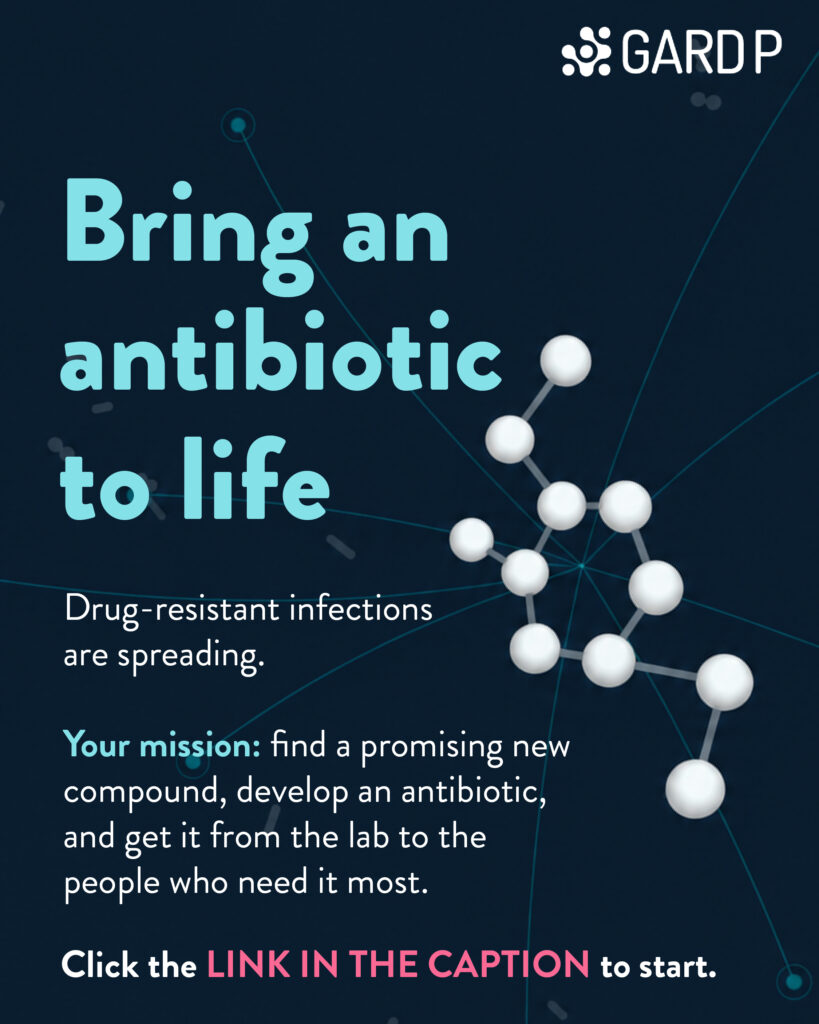
Bring an antibiotic to life – 18 November
What does it take to turn a promising compound into an antibiotic that can reach the people who need it?
Our new interactive game puts you in the driver’s seat. Make seven decisions along the journey from discovery to supply, including which infections to focus on, where to conduct clinical trials, who to partner with and when to start planning for access.
Along the way, discover how public health needs, partnership, access and responsible use can be built into antibiotic development from the start.
How many times will you choose the GARDP way?
Building access in from the start – 19 November
Developing a new antibiotic is only part of the challenge. We also need to think about how it will reach the people who need it.
Zoliflodacin shows why access planning needs to start well before an antibiotic is approved.
Its phase 3 trial, co-led by GARDP and Innoviva Specialty Therapeutics, was conducted in countries with a high burden of gonorrhoea, including South Africa and Thailand. The trial also included women, adolescents and people living with HIV, helping generate evidence that reflects populations affected by the infection.
From generating the right clinical evidence to planning for registration, supply and responsible access, see how access can be built into antibiotic development from the start.
Giving newborns a fighting chance – 20 November | World Children’s Day
Every child deserves the chance to survive and thrive. Yet newborns remain underrepresented in antibiotic research, leaving important gaps in the evidence doctors need to treat life-threatening infections such as bacterial sepsis.
Every year, up to 3 million newborns develop serious infections that can lead to sepsis. Across Africa and Asia, our NeoSep1 trial is testing new antibiotic combinations to build evidence for treating antimicrobial resistance in newborns.
This World Children’s Day, hear from researchers involved in NeoSep1 about the challenges they face and what better evidence could mean for newborn treatment.
How well do you know the pathogens driving AMR? – 21 November
Some bacteria cause hundreds of thousands of deaths each year. Others are becoming increasingly difficult to treat as resistance erodes the effectiveness of existing antibiotics.
They have something else in common: they are among the priority pathogens identified by the World Health Organization as being in urgent need of new treatments.
GARDP focuses on priority pathogens, unmet treatment needs and the people most affected.
Think you know the bacteria behind some of the most harmful drug-resistant infections? Put your knowledge to the test.
Turning access plans into supply – 22 November
For countries facing high levels of drug-resistant infections, having an effective antibiotic is only part of the solution. Reliable and sustainable supply matters too.
Cefiderocol, a last-resort antibiotic for serious bacterial infections, illustrates how technology transfer and local manufacturing can help address this challenge.
By bringing together the developer, manufacturing expertise and access partners, GARDP is working towards a pathway for more sustainable access in countries with unmet need, together with Shionogi, Orchid Pharma and the Clinton Health Access Initiative (CHAI).
Discover how sharing technology can help turn access plans into supply.
Building evidence where it matters – 23 November
Resistance does not look the same everywhere. Understanding the bacteria circulating locally is essential to knowing how best to use the antibiotics available.
Scientists from Colombia, Costa Rica and Barbados recently came together in Bogotá with the University of Liverpool to strengthen the response to AMR. For the first time, bacteria from Latin America and the Caribbean are being included in this research.
Supported by PAHO, GARDP and the University of Liverpool, the work is strengthening regional expertise while generating evidence relevant to local treatment needs.
Together, our response is bigger – 24 November
No single organization, country or sector can tackle AMR alone.
It takes researchers, manufacturers, regulators, health ministries, clinicians and funders working together.
This World AMR Awareness Week, we have looked at different parts of the response: developing new treatments, generating better evidence, strengthening access and protecting the antibiotics we already have.
From newborn units in Ghana to laboratories in Colombia, each story shows how collaboration can turn scientific progress into a public health response.
Drug-resistant infections do not stop when World AMR Awareness Week ends, and neither does the work.
Continued collaboration is essential to develop new antibiotics and ensure they reach the people who need them.
Together, our response is bigger.