

Investing in next-generation antibiotics for all.
Mitigating the effects
of 21st century global challenges.
AMR is a health security threat that lies at the intersection of major global challenges of the 21st century. On the one hand, AMR erodes the effectiveness of antibiotics, which are the very foundation of modern medicine, potentially reversing decades of progress. In addition, rising global insecurity – due to challenges such as conflict, mass migration, climate change and pandemics – is making the burden of AMR even worse.
To invest in GARDP is to offset the impact of these challenges on public health.

Cancer
Cancer patients receiving chemotherapy are more at risk from drug-resistant infections as the treatment weakens their immune systems.
Bacterial infections are now associated with half of all cancer-related deaths.

Conflict
During war and conflict, water and sanitation systems are disrupted, health systems and medical supply chains are overburdened or debilitated.
Infections, including drug-resistant ones, spread through war wounds and broken health systems more easily.

Climate change
Warming climates accelerate bacterial mutations that become more resistant.
This is worsening the rise and spread of drug-resistant infections as migration increases.

Pandemic preparedness and response
Drug‑resistant infections make pandemics deadlier by increasing secondary bacterial infections and limiting treatment options.
Pandemics, in turn, drive up antibiotic use and accelerate drug resistance, creating a dangerous cycle that undermines global health security.
A public health-driven model to tackle AMR.
Drug-resistant Gram-negative infections are now outpacing our ability to treat them. This is either because the right antibiotics are not reaching the people who need them, or because new treatments are not being developed in the first place.
To address this public health failure, GARDP is pioneering an innovative R&D and access model. The new approach prioritizes the development and access to new antibiotic treatments that specifically target priority pathogens, and are affordable and relevant for the key regions and populations hardest hit by AMR.
Value for money.
As a non-profit, GARDP is dedicated to delivering exceptional value for money in the way it develops new antibiotic treatments. By collaborating through a network of partners, GARDP is able to avoid a large, centralized structure with many staff and overheads. This dynamic network, encompassing entities from both the Global North and Global South, works collaboratively to produce cost-effective and pertinent innovations, ensuring optimal value for both donors and the people we serve – those most affected by antibiotic resistance.
GARDP maximizes the impact of its funding and mitigates risk by actively managing its portfolio and operations. Projects are phase-gated, with funds deployed only after milestones are met. Organizational overheads remain intentionally low due to a flat hierarchy and global talent retention. This disciplined model – focused on financial prudence, efficiency, effectiveness and equity – ensures that donors pay only for work focused on public health needs, accelerating access to innovative antibiotics where they’re needed most.
2024-2028 funding need.
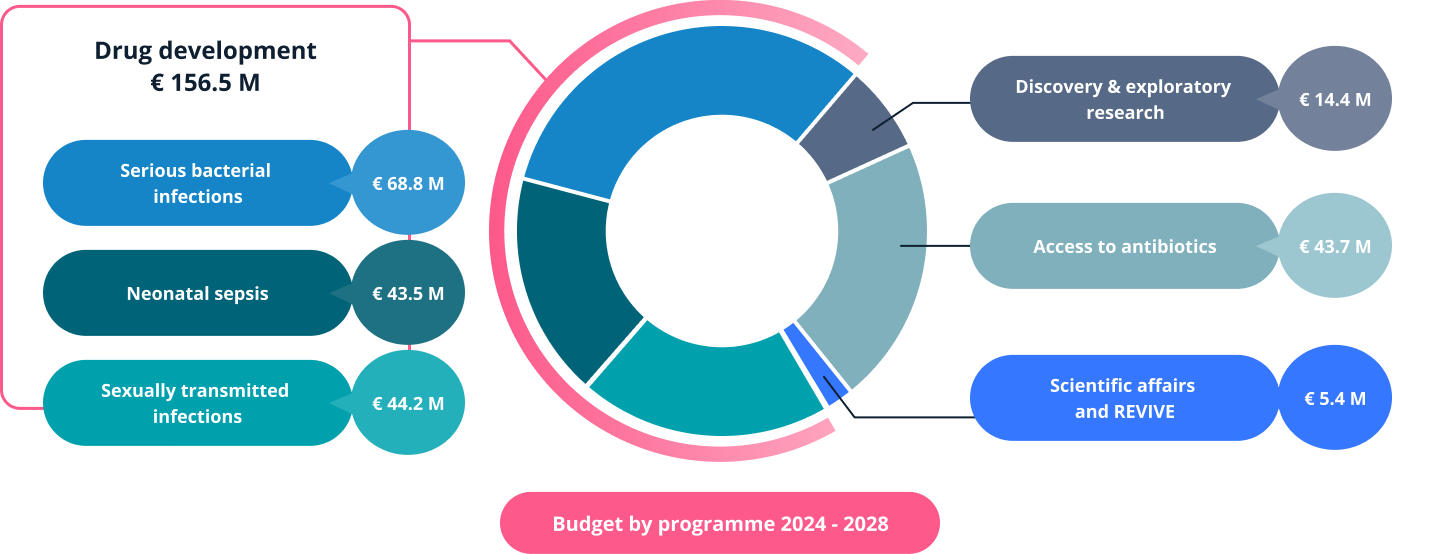
For the period 2024–2028, delivering on GARDP’s strategy is estimated to cost €220 million.
This covers activities to address immediate urgent public health needs for antibiotics, while also strengthening a sustainable ecosystem needed for antibiotic research, development and access to meet future global needs.

Maximizing impact with core funding.
To undertake the complex research and development of new and effective antibiotic treatments and ensure they are made available, every part of GARDP’s integrated R&D and access model must be adequately funded. This not only means securing a balanced level of investment across programmes, but also a reasonable proportion of core, unrestricted funding to sustain the organization’s model as a whole.
When available at a sufficient scale, core funding provides the timely, predictable and flexible resources needed for long-term strategic and operational planning. It strengthens GARDP’s ability to respond with speed and agility to a rapidly evolving public health landscape, and pivot when necessary. Core funding also provides the flexibility to adopt impactful innovations and seize critical opportunities as they arise.
Yet across global health, flexible funding is increasingly scarce. More grants are earmarked for individual projects, narrowing organizational focus and fragmenting effort. This project-by-project approach can pull an organization away from its core mandate, weaken strategic alignment and reduces overall impact. It can also drive cost inefficiencies if systems and operations are duplicated across projects rather than strengthened across the organization. Unrestricted funding, on the other hand, bolsters the foundation of the organization itself, which is vital to tackle the complex, systemic challenges of AMR research, development and access.