

Discovery and exploratory research.
The critical need for discovering next-generation antibiotics.
GARDP’s Discovery and Exploratory Research (DER) programme works to deliver innovative preclinical antibiotic candidates that can become next‑generation treatments against drug‑resistant infections. It focuses on finding new antibiotic substances and uncovering untapped bacterial vulnerabilities. This is important because with drug resistance now beginning to outpace antibiotic development, the pipeline for new antibiotics is drying up. Most antibiotics in use are over 40 years old, and of the handful in development, fewer than 10% target priority pathogens, those which according to the World Health Organization (WHO) pose the greatest public health threat.
Antibiotic discovery is difficult, risky and underfunded. Pharmaceutical investment has dropped, there are fewer researchers and failure rates are exceptionally high due to scientific and commercial challenges. The challenge is even more tricky for difficult-to-treat Gram-negative bacteria that have additional mechanisms to evade antibiotics.
The world needs a new arsenal of antibiotic treatments with never-before-seen modes of action and other novel tactics.
GARDP’s public-health-first approach to antibiotic discovery and exploratory research.
Our DER programme flips the traditional antibiotic research model by prioritizing solutions that meet the needs of high‑burden regions and put public health and affordability first. It focuses on novel antibiotics, especially for difficult-to-treat infections such as those caused by Klebsiella pneumoniae and Acinetobacter baumannii, while ensuring treatments are practical for low‑ and middle‑income countries – stable without cold chains, low‑cost to produce and effective when taken orally where clinically appropriate.
This work is strengthened through global collaboration and the integration of advanced experimental, computational and AI-driven approaches to accelerate antibiotic discovery.
Programme goals
GARDP aims to demonstrate how its unique antibiotic R&D partnership model can help address the global AMR public health failure by enabling the right antibiotic treatments to be developed and made available to people who need them.
The DER programme has therefore set the following goals:

Goal 1
Use novel technologies and the best science to identify new substances (compounds) with potential for drug development and any potential new bacterial vulnerabilities that they can target.

Goal 2
Share discoveries, knowledge and tools with the global research community to accelerate antibiotic R&D.
Our DER projects
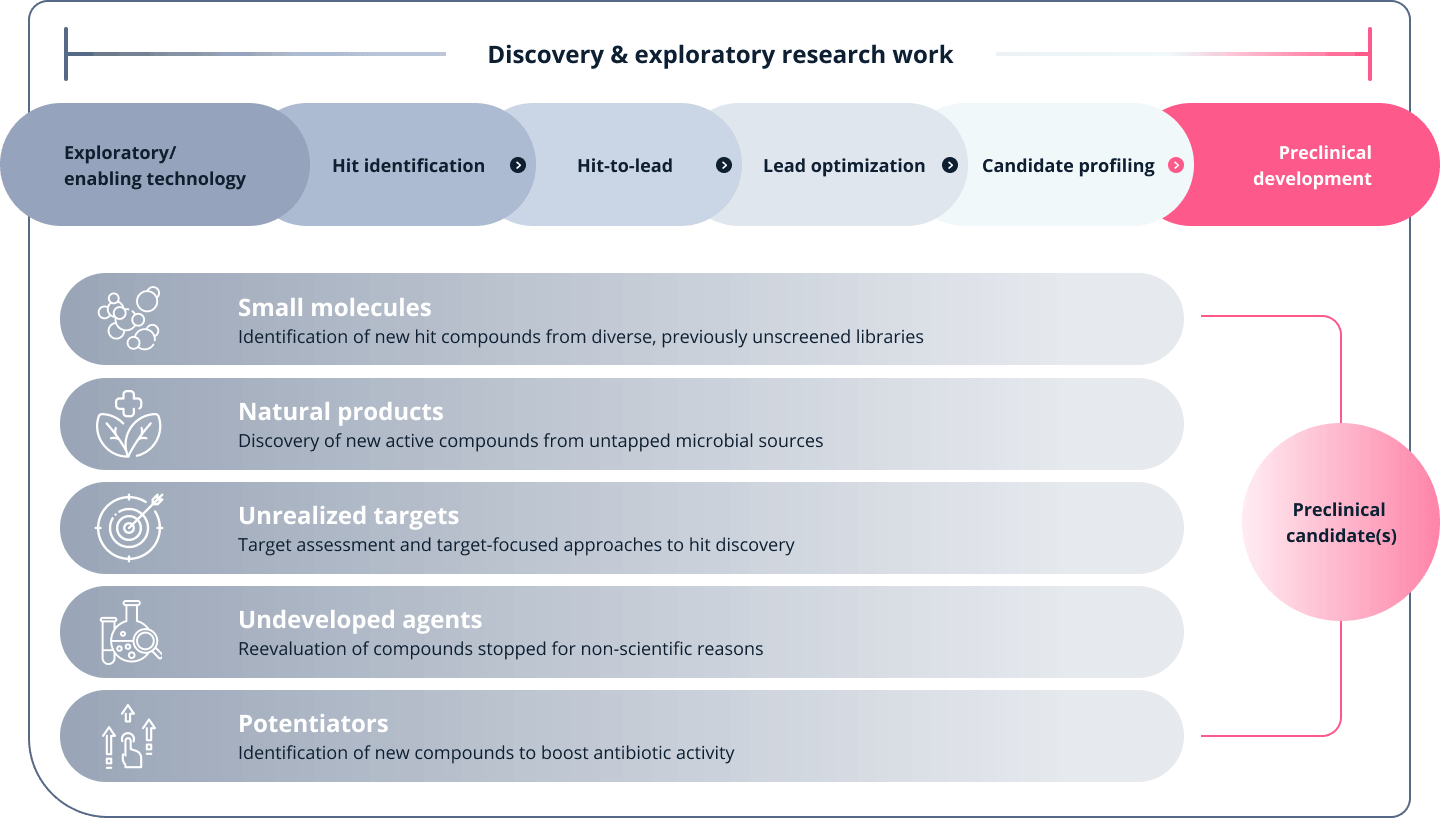
GARDP is working toward identifying a candidate or candidates for preclinical development through five research areas: small molecules, natural products, unrealized targets, undeveloped agents, and potentiators.